How we build
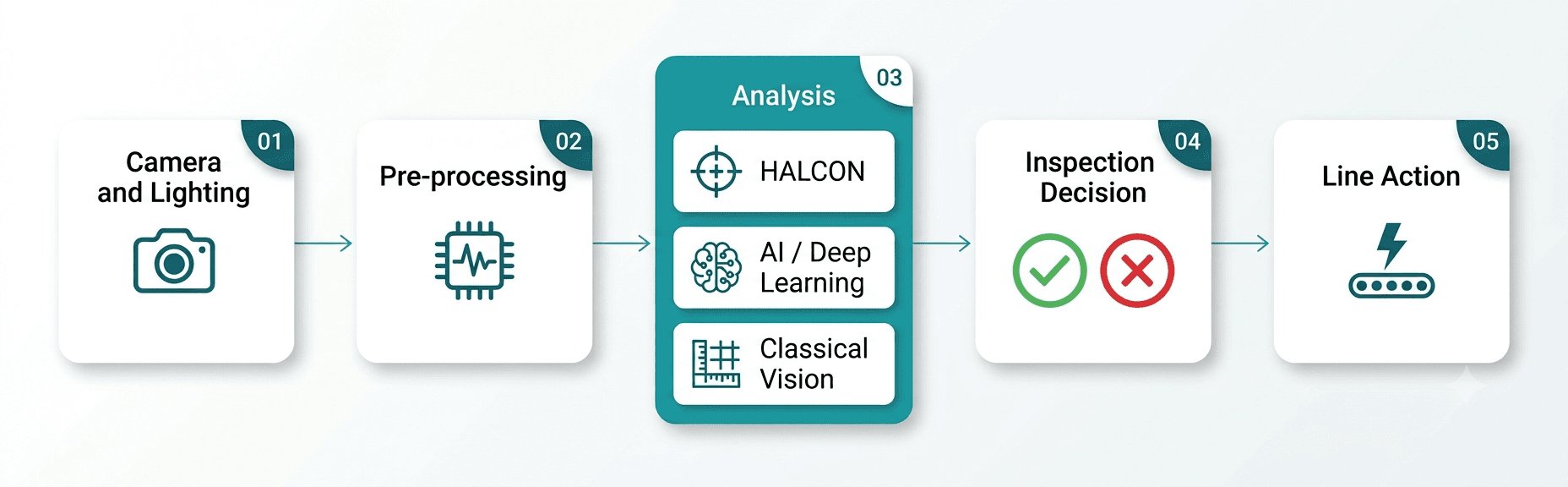
AMV does not use a single tool for everything. We combine proven industrial vision software with custom AI models and classical algorithms, applying each where it performs best. This is what makes a custom system more accurate and more reliable than an off-the-shelf product.
Camera and Lighting
Every system starts with the right camera, lens and lighting for your product and line speed. Lighting angle, wavelength and intensity are often what make a defect visible rather than missed. We design the imaging setup as part of the system, not an afterthought.
Technology stack
Software, AI and classical vision
What it is
HALCON is a professional, purpose-built library for industrial machine vision. It provides precise optical measurement, calibration, and rule-based defect detection that has been validated on production lines for decades.
Why it matters to you
When the inspection task is well defined, such as measuring a gap to the nearest tenth of a millimetre or confirming a barcode grade, HALCON delivers rock-solid accuracy and repeatability at full line speed. It does not learn or guess: it measures.
The HALCON and AMV Deep Learning hybrid
AMV combines HALCON with its own custom-trained deep learning models in a single system. HALCON handles the precise, rule-based parts of the inspection. Our deep learning models handle the variable, hard-to-define parts that rigid rules miss. One system, the right technique applied to each task.
The full picture
How it comes together
AMV owns the full pipeline. Camera selection, lighting design, software development, on-site commissioning. Because we control every stage, we choose the right tool for each part of the problem rather than forcing one approach across the whole system.
In practice that means a single system might run HALCON for precise dimensional gauging, a custom AI model for surface defect detection, and classical edge detection for label placement, all in parallel at full line speed.
Custom-built means built around your product, your line, and your defect types. Not a standard product with your logo on it.